Image

The Institutes’ Councils and their Executive Directorates express their shock and deep concern at the events unfolding in Ukraine. We strongly condemn the aggression by the Russian Federation government towards an independent Ukraine and demand that the diplomatic route and dialogue prevail. We would like to encourage everyone to find ways to help the Ukrainian people, and we share with you some links with initiatives to help Ukrainian researchers:
Joint statement supported by:
ICCUB, IRCVM, IAUB, IRBio, UBICS, IPOA, GEOMODELS, INSA, IREA, UBneuro, IBUB, IN2UB, IQTC, IRE, IMUB, BEAT, IdRA, TransJus, IRCVM
We have witnessed the birth of a new era of scientific discoveries with the first detection of gravitational waves by the LIGO observatory in 2015. In the following years, other detectors such as Virgo and Kagra have become active, accompanied by a sustained improvement of the sensitivity of all detectors. These improvements have paid off: in each observing campaign the number of events has rapidly increased and qualitatively new phenomena have been observed. Thanks to these discoveries, we have learned an enormous amount about the Universe such as the existence of a whole range of black hole masses, the formation of heavy elements in neutron star collisions, the propagation of gravity to the speed of light, among many others.
As successful as these observatories have been, even more substantial upgrades are needed in order to fully unlock the potential that the study of gravitational waves encloses. Having this in mind, the idea of the ground-based gravitational wave observatory Einstein Telescope was conceived in 2005. The core concepts are fairly similar to previous ground-based detectors. The key modifications are mainly its length — it will be 10km long as opposed to 4km in LIGO and 3km in Virgo and Kagra — and its noise cancelling technology will allow it to detect waves down to 1 Hz — as opposed to LVK which are insensitive to waved below 30 Hz.
By virtue of these characteristics, the Einstein Telescope will allow us to probe a huge range of events, which will undoubtedly have a large impact in the fields of Astrophysics, Cosmology and Fundamental Physics.
The idea of the Einstein Telescope has become a project with its inclusion in the European Strategy Forum on Research Infrastructures (ESFRI) Roadmap 2021. Einstein Telescope will be part of the EU agenda for its establishment joining the currently over 50 European Research Infrastructures. The successful ESFRI proposal means that ET enters its 1 preparatory phase, which entails bringing the project to the level of legal, financial and technical maturity required for implementing it.
The European framework programme Horizon Europe has opened the call HORIZON-INFRA-2021-DEV-02 for those projects included in the ESFRI Roadmap to fund the preparatory phase. The ET collaboration is preparing a proposal that will be submitted during January 2022 which addresses the legal and financial framework, logistics, human resources, technical challenges and development plans among other important aspects related to the setting-up. The success of the ESFRI proposal, submitted by the Italian government and supported by Belgium, Netherlands, Poland and Spain, foresees the beginning of construction in 2026 and first observations in 2035.
The University of Barcelona through the ICCUB participates in the proposal, committing to contributions in computing and outreach. Moreover, some of the members of the gravitational waves group at the ICCUB are members of the Observational Science Board of ET, making our participation transversal. This early stage involvement with the experiment gives us the possibility of taking advantage of our previous expertise and growing in the directions we consider strategically relevant for the institute.
This is only the beginning of an exciting journey, which will open up new research avenues and collaboration. Please contact Juan Trenado (jtrenado@fqa.ub.edu) or Tomas Andrade (tandrade@icc.ub.ed) if you are interested in getting involved.
The former researcher of the Institute of Cosmos Sciences (ICCUB-IEEC), José Luís Bernal, received yesterday the XXV 2021 Doctoral Senate of the University of Barcelona Second Prize for his doctoral thesis "Cosmology on the Edge of the Λ-Cold Dark Matter”.
This award aims to distinguish the theses defended at the University of Barcelona that make relevant contributions to human knowledge and foster scientific progress.

Supervised by the ICCUB’s cosmologist Licia Verde, Dr Bernal defended his thesis at the University of Barcelona in 2019 and since then, he has obtained the recognition of the XVI Prize for the Spanish Doctoral Thesis in Astronomy and Astrophysics by the Spanish Astronomical Society (SEA) as well.
At the moment, he is doing a postdoctoral stay in the Department of Physics and Astronomy at Johns Hopkins University (JHU,Baltimore, United States) where he continues his work on the use of different approaches to understand the nature of the early Universe, the dark matter and dark energy. These problems are approached both from a theoretical point of view and by analysing observational data with new statistical techniques. In addition to his work on stress in determining the Hubble constant, he is also interested in large-scale observations of the Universe, mapped using line intensities, and in galaxy surveys.
The Institute of Cosmos Sciences (ICCUB-IEEC) researcher, Héctor Gil Marín, has received the Young Theoretical Physics Researcher Award from the Spanish Royal Society of Physics (RSEF) and the BBVA Foundation.
The double ceremony, for the 2020 and 2021 awards, took place last Tuesday December 14 in Madrid and the director of the BBVA Foundation, Rafael Pardo, and the president of the RSEF, Luis Viña, hosted it.

“This ceremony is a celebration of knowledge, and what we celebrate is the most solid alternative to irrationality, falsehood, relativism and charlatanism” highlights Rafael Pardo. “In a positive note, we also celebrate what historian Gerald Holton, winner of the Frontiers of Knowledge Award, referred to as the ‘Apollonian Spirit’, the search for beauty, the belief that the natural and social worlds are comprehensible, that it is possible to get closer to the truth, without ever reaching it, but closer and closer every time. Surely no other field represents this game and dialogue between observation and reason, between empirical proof and theory, as physics does”.
The jury highlighted Dr. Gil Marín’s outstanding contributions to the analysis and interpretation of galaxy mapping, advancing our understanding of the accelerated Universe, and being undoubtedly one of the most brilliant researchers in the field of the cosmology of his generation.
Dr. Gil-Marín was a member of the BOSS and eBOSS international collaborations and is a current researcher of DESI, where he plays a leading role in the survey mapping. He actively participated in the analysis of BOSS and eBOSS data, which resulted in the recently published largest three-dimensional map of the distribution of galaxies. His research focuses on the large-scale structure of the Universe, and he intends to answer one of the most fundamental questions in cosmology for the past 20 years, what drives the late-time accelerated expansion of the Universe.

About the Honoree
Dr. Héctor Gil-Marín obtained a PhD in Physics in 2012 at the Universitat de Barcelona. Prof. Gil-Marín has been a postdoctoral research associate at the Institute of Cosmology and Gravitation, University of Portsmouth (UK) and a Lagrange fellow at the LPNHE at the Université Pierre et Marie Curie (Paris). From 2018, Dr. Gil-Marin holds a Junior Leader 'La Caixa' fellowship at the ICCUB.
Selected publications
More information:
An international team of astronomers led by the researcher Gemma Busquet of the Institute of Cosmos Sciences (ICCUB-IEEC), has been granted 306 telescope hours for their observational project “VOLS: The VLA Orion A Large Survey”.
This survey will observe the northern region of the molecular cloud Orion A using the Karl G. Jansky Very Large Array Telescope in New Mexico (USA) to build a census of the stellar population, characterize their radio emission and quantify their rates of mass loss (ejected from the star) and mass accretion (fallen into the star from the stellar disk) and how these quantities determine the final properties of stars.
The observations will focus on two radio frequency bands. This will be the first radio study to cover a large area of Orion A at subarcsecond resolution, improving the sensitivity by a factor of 20 compared to previous large-scale surveys in Orion.

The main goal of this survey is to study the evolution of young stellar objects (YSOs) and protostars (which are the earliest phases of the life of a star) to determine the properties of stars and planetary systems. The early stages of star and planet formation involve a balance between accretion and ejection of material during the gravitational collapse. This balance and the consequent protostellar evolution are crucial in determining the final properties of stars and their planetary systems.
In this context, both mass accretion rate and mass-loss rate are fundamental, albeit still uncertain, quantities in star formation. It is, therefore, logical to ask how these quantities evolve with time and, just as importantly, how they vary across the entire mass spectrum.
The team proposes the VLA Large Program VOLS to investigate how these rates vary with protostellar evolution, and how they depend on the initial conditions (i.e., the environment) and on the mass of the star.
To answer these questions, the team will use the Very Large Array Telescope to observe the northern part of the molecular cloud Orion A, covering an area of approximately 0,5 deg2 (which is roughly four times the size of the moon in the sky). Orion A is the nearest star-forming complex containing a broad range of environments populated by protostars and YSOs with different masses and evolutionary stages, representing a testbed for star formation theories.

Together with previous datasets, such as Gaia DR3, VOLS will provide the ultimate correlation between the characteristics of the radio emission from YSOs and their properties. This project is crucial for the next generation of centimetric interferometers such as the Square Kilometer Array (SKA) or the ngVLA since it will provide a radio template of YSOs and protostars.
VOLS counts with 46 researchers around the globe, including several members of the ICCUB and the Institut of Space Sciences (ICE, CSIC).

A team of astronomers led by the researcher Gemma Busquet of the Institute of Cosmos Sciences (ICCUB-IEEC), have been granted 306 telescope hours for their observational project “VOLS: The VLA Orion A Large Survey”. This survey will observe the northern region of the molecular cloud Orion A using the Karl G. Jansky Very Large Array Telescope in New Mexico (USA) to build a census of the stellar population, characterize their radio emission and quantify their rates of mass loss (ejected from the star) and mass accretion (fallen into the star from the stellar disk).
The observations will focus on two radio frequency bands. This will be the first radio study to cover a large area of Orion A at subarcsecond resolution, improving the sensitivity by a factor of 20 compared to previous large-scale surveys in Orion.
Credit: NRAO/AUI/NSF, Jeff Hellerman
The main goal of this survey is to study the evolution of young stellar objects (YSOs) and protostars (which are the earliest phases of the life of a star) to determine the properties of stars and planetary systems. The early stages of star and planet formation involve a balance between accretion and ejection of material in gravitational collapse. There is hence an underlying accretion-ejection connection that governs and keeps track of the protostellar evolution, crucial in determining the final properties of stars and their planetary systems.
In this context, both mass accretion rate and mass-loss rate are fundamental, albeit still uncertain, quantities in star formation. It is, therefore, logical to ask how these quantities evolve with time and, just as importantly, how they proceed in the same way across the entire mass spectrum.
The team proposes the VLA Large Program VOLS to investigate how these rates vary with protostellar evolution, and how they depend on the initial conditions (i.e., the environment) and on the mass of the star.
To answer these questions, the team will use the Very Large Array Telescope to observe the northern part of the molecular cloud Orion A, covering an area of approximately 0,5 deg2(which is roughly four times the size of the moon in the sky). The motivation behind this choice is that Orion A is the nearest star-forming complex containing a broad range of environments populated by protostars and YSOs with different masses and evolutionary stages, representing a testbed for star formation theories.
Together with previous datasets, such as Gaia DR3, VOLS will provide the ultimate correlation between the characteristics of the radio emission from YSOs and their properties. This project is crucial for the next generation of centimetric interferometers such as the Square Kilometer Array (SKA) or the ngVLA since it will provide a radio template of YSOs and protostars.
VOLS counts with 46 researchers around the globe, including several members of the ICCUB and the Institut of Space Sciences (ICE).
From left to right: Gemma Busquet (ICCUB-IEEC), Josep Miquel Girart (ICE),
Rosario López (ICCUB-IEEC), Robert Estalella (ICCUB-IEEC), Bo Huang (ICE) and Chema Torrelles (ICE)
This autumn, ten new researchers have arrived the Institute of Cosmos Sciences to continue their academic careers. We are very excited to welcome them to our institution and we hope that they have an enriching experience here, both academically and personally!
The Institute was created in 2006 as the instrument of the University of Barcelona for the active support of research in theoretical astrophysics and particle physics, paying special attention to their synergy with cosmology. Since then, it has become a consolidated research institution with more than 50 long term scientists, 15 engineers and 65 postdoctoral researchers and PhD students. With every new addition, we grow as a community and we position ourselves in the international research landscape. Now, we would like to introduce you to these researchers. If you want to get to know them a little bit better, keep on reading!
ALEXANDRE SERANTES
Dr. Serantes got a PhD at the University of Santiago de Compostela and then worked as a postdoctoral fellow at the International Centre for Theoretical Sciences and at the National Centre for Nuclear Research, where he worked in topics such as holography, relativistic hydrodynamics and numerical relativity. He has now joined the ICC to continue to pursue this research line. Besides theoretical physics, he also enjoys reading, walks and going to the cinema.
AYAKA USUI
Dr. Usui obtained her PhD at the Okinawa Institute of Science and Technology Graduate University in Japan. This is her very first postdoctoral stay and she plans to continue her work on cold atoms as well as explore the fields of quantum simulation and quantum thermodynamics. In her spare time, she enjoys jogging and going sightseeing in the city of Barcelona.
CHERVIN LAPORTE
Dr. Laporte obtained his PhD at the Max Planck Institute for Astrophysics. His expertise covers a wide range of fields such as galactic dynamics, computational cosmology, galaxy formation and interpretation and data mining of large astronomical datasets. Dr. Laporte was awarded an ERC Starting Grant by the European Research Council (ERC) in its 2019 call for his project “Numerical Simulations of the Milky Way’s Accretion History (VIA LACTEA)” which will allow him to work on the formation and evolution of the Milky Way. Outside astrophysics, he enjoys playing jazz music on the piano and scuba diving.
JUAN PEDRAZA
Dr. Pedraza obtained his PhD at the University of Texas at Austin (USA) and then went on to work as a postdoc researcher at the University of Amsterdam, then the University College London and finally at Brandeis University. This 2021 he has joined the ICCUB as a La Caixa Junior Fellow to keep on working on the interplay between gravity and quantum information theory. He aims to tackle questions pertaining to the emergence and dynamics of space-time, entanglement entropy and quantum chaos. Outside of physics, he enjoys chess-playing, vintage Jazz and Lindy-Hop dancing.
MARIA MONGUIÓ
Dr. Monguió started her academic path at the University of Barcelona, where she obtained her Physics degree, master and PhD. She has been working as a postdoc at the Universities of Alicante and Hertfordshire before returning to Spain. Her expertise focuses on the kinematics and dynamics of the spiral arms as seen through BA stars. She is also a survey working group member of WEAVE. During next few years she plans to use WEAVE data, combined with Gaia, to study the structure and dynamics of the Galactic disc.
NILS SCHÖNEBERG
Dr. Schöneberg obtained both his MSc and PhD at the RWTH in Aachen, Germany. He has been mostly focused on different aspects of cosmology, from improving the numerical side of many codes, investigating the future constraining power of spectral distortions all the way to analysing various dark matter models and their impact on cosmology. In his spare time, he enjoys hiking, baking and writing short stories or programming games. He also has an interest on outreach initiatives since he used to run a YouTube channel educating people on STEM fields!
ROBIE HENNIGAR
Dr. Hennigar completed his MSc and PhD degrees at the University of Waterloo, Canada. After completing his PhD, he was awarded Canada’s prestigious Banting Postdoctoral Fellowship, for which he was hosted at Memorial University of Newfoundland. Hennigar’s research concerns gravitational theory and focuses on black holes in particular. His most significant contributions have been to our understanding of the thermodynamics of black holes, and the theoretical implications of modified theories of gravity. He is also interested in the interplay of quantum physics and gravitation through the lens of holographic duality and quantum information. Outside of physics, he enjoys reading, hiking and cycling.
RUXANDRA BONDARESCU
Dr. Bondarescu began her journey at Cornell University where she got her PhD and MSc. Prior to coming to Barcelona, she has worked at the Centre for Gravitational Waves Physics at Penn State University, and then she was a fellow at the Institute of Theoretical Physics at the University of Zurich. Her current work focuses on learning more about the evolution of the universe from gravitational waves. In her own words – “It's fabulous to finally be able to measure these spacetime waves and to use them to learn about the matter that curves spacetime”. In addition to being a scientist, she is also a mother of three children. In her spare time, she writes books with them.
SERGIO ARGUEDAS
Dr. Arguedas obtained his PhD at CERN in Switzerland. During this period, he worked primarily on the search for dark matter. He was part of the CERN Axion Solar Telescope (CAST) collaboration as a member of the RADES group where they used a resonant cavity inside of a magnetic field to search for a dark matter candidate called the axion. He plans to continue on this line of research here at the ICC and broaden his sources by using data from Dark Matter searches at the LHCb. During his free time, he enjoys dancing and bike riding.
SHOHEI OKAWA
Dr. Okawa obtained his MSC and PhD at the Nagoya University, Japan. He then proceeded to work at the Technical University of Munich and the University of Victoria, Canada, where he focused on low energy phenomena induced from dark sectors that only feebly interact with the SM. He extensively studied how electric dipole moments are generated from CP violation in dark sectors. At the ICC, he will keep working on dark sector physics while also evaluating radiative corrections to axion couplings to the SM fermions and gauge bosons at low energy, which play a crucial role in experimental searches for axions or axion-like particles. In his free time, he loves watching and playing football as well as tasting local beers.
Now you know a little bit more about our newest members! We would like for all of you to join us in giving these new researchers our warmest welcome to our community.
Raimon Luna, a former Institute of Cosmos Sciences PhD student, has received the second prize of the XVII Ramon Margalef Award to the best article published in a renowned scientific magazine derived from a doctoral thesis read at the University of Barcelona in the last five years.
The name of the recognised paper, which appeared on the Journal of High Energy Physics on April 18 of 2019, is “Cosmic censorship violation in black hole collisions in higher dimensions” and it was written along with co-authors Tomás Andrade (ICCUB), David Licht (ICCUB) and Dr Luna’s thesis advisor, Roberto Emparan (ICREA, ICCUB). The main contribution of Raimon Luna consisted on the development of an efficient algorithm to solve the dynamic equations for black holes based in spectral numerical methods. The simulations obtained with this algorithm, support the hypotesis of a violation of the Weak Cosmic Censorship hypothesis in high angular momentum conditions. This code has also allowed the team to analyse in detail the final state of black hole collisions and to locate them in a phase diagram.
With this paper, the authors have presented the first theoretical evidence that black hole collisions can yield naked singularities, which are spacetime points where the laws of Einstein’s General Relativity break down. This result hints at the necessity of new physics beyond the current theory of gravity.
The Ramon Margalef award is a subcategory of the Awards of the Social Board of the University of Barcelona given to the best scientific works derived from doctoral thesis read at the UB. The University of Barcelona regards its doctoral programmes as one of its crucial assets to improve our knowledge of the world around us and to foster a high quality research to give back to society the adquired knowledge.
The award ceremony will take place on Wednesday, December 1st at 6 pm at the Aula Magna of the Historic Building of the University of Barcelona. Please join us at the event to offer our congratulations to Dr Luna.
The installation of the William Herschel Telescope Enhanced Area Velocity Explorer (WEAVE) at the William Herschel Telescope in La Palma (Canary Islands) is underway, so the WEAVE team is on the cusp of offering astronomers a new and improved eye on the stars.
For those who do not know, WEAVE is a multi-object survey wide-field spectrograph that will allow researchers to obtain the spectra of up to almost 1000 objects over a two-degree field of view in a single exposure. Its goals are to complement the major space- and ground-based programmes in the current and coming decade, including Gaia, LOFAR and Apertif, by providing a dedicated wide-field optical spectroscopic instrument in the Northern Hemisphere. It is being installed at the William Herschel Telescope (WHT), which is part of the Isaac Newton’s Group of Telescopes (ING) in La Palma, Canary Islands. Its fibre-fed spectrograph comprises two arms, one optimised for the blue side of the spectrum and one for the red side.
The main components of WEAVE are:
Following a year of installation of close to 100 km of optical fibre assemblies, WEAVE's fibre positioner has made the journey from the UK, and has now been tested and calibrated (its arrival and unpacking are documented in this photo sequence). The positioner is able to place full configurations of over 900 fibres in under one hour using its two high-speed industrial robots (video). Each fibre collects light from an individual object in the sky and feeds it around the telescope structure to the spectrograph. Thanks to the two different plates, one of them can be observing while the fibers are being positioned in the other one.
The instrument also allows for Integral Field Unit (IFU) observations with a large IFU mode covering 78 x 90 arcsec2 and a set of 20 miniIFU bundles of 11 x 12 arcsec2 each. Two different spectral resolutions will be available: a low resolution mode at R~5000 covering the spectral ranges 3660-6060 and 5790-9590 A, and a high resolution mode at R~20000 covering 4040-4650 and either 4730-5454 or 5950-6850 A.
|
|
|
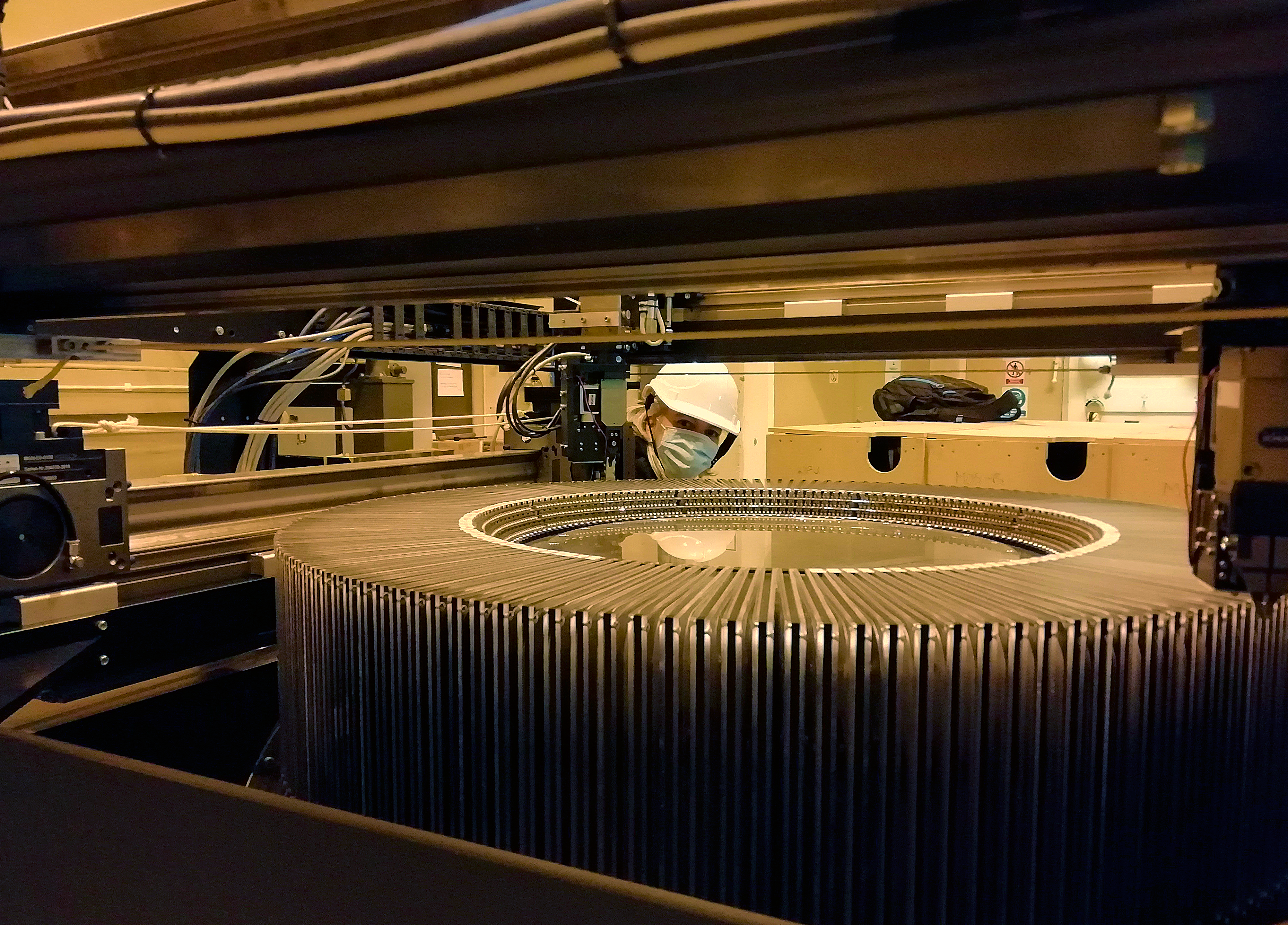
WEAVE's fibre positioner after being unpacked at the WHT. In the centre of the image one of the MOS fibre plates can be seen, surrounded by three layers of parked fibre ends and, around these, the fin-like fibre-retractor boxes. Credit: Isaac Newton Group of Telescopes, La Palma. Large format: PNG. |
|
|
|
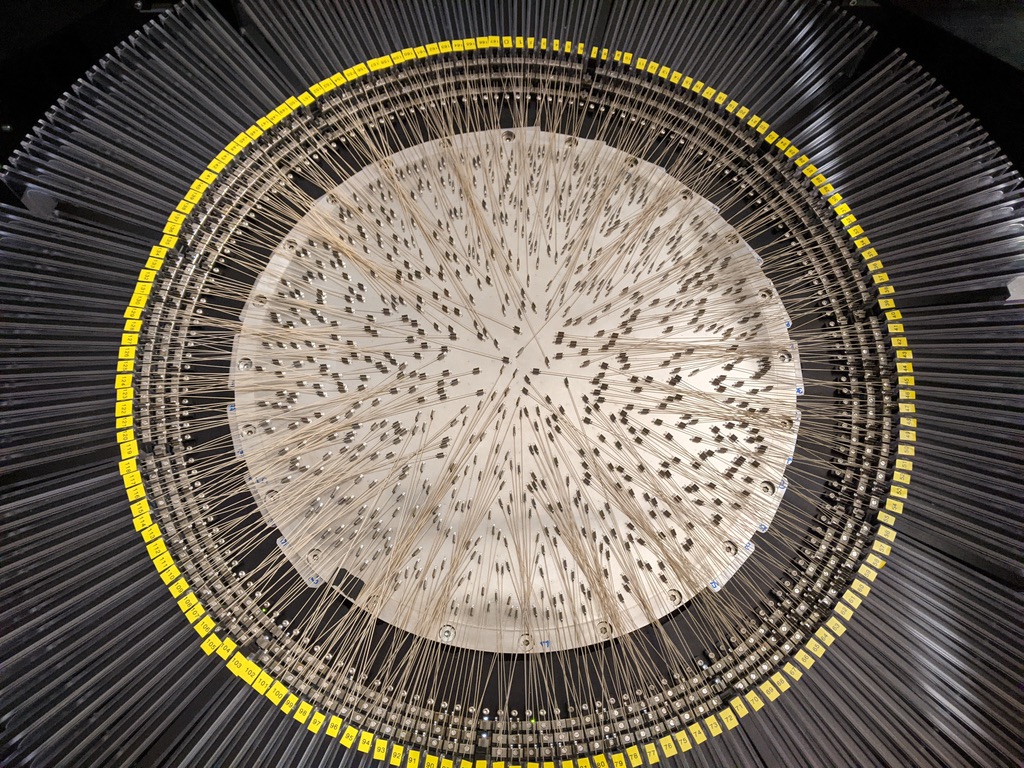
A fully-configured WEAVE field, with 700 of around 950 fibres placed by two robots (out of frame), on location in the WHT. Large format: JPG. Movies showing the two robots placing the fibres on plate: MP4 (1), MP4 (2). Credit: Gavin Dalton/U. Oxford and STFC's RAL Space. |
The installation of WEAVE marks a huge milestone in astronomy for several reasons. It will extend the telescope’s field of view to two degrees on the sky (or four times the apparent diameter of the moon), allowing it to capture the spectra of up to almost a thousand stars per hour. This will enable the detector to provide data from more than 12 million spectra, which will enhance the science return from Gaia, following up on Gaia’s sources and deepening the impact of both projects.
|
On-sky tests of the new prime-focus corrector (PFC) confirm that it delivers very sharp images, ensuring that in good seeing a given MOS fibre will collect 80% of the light, over a field of view 2 degrees, at all wavelengths from the ultra-violet to the far red. Following successful tests of the new PFC, and while integration of WEAVE proceeds at the WHT, one of the CMOS imagers used for the PFC tests has been offered to the community for science programmes. |
|
|
|
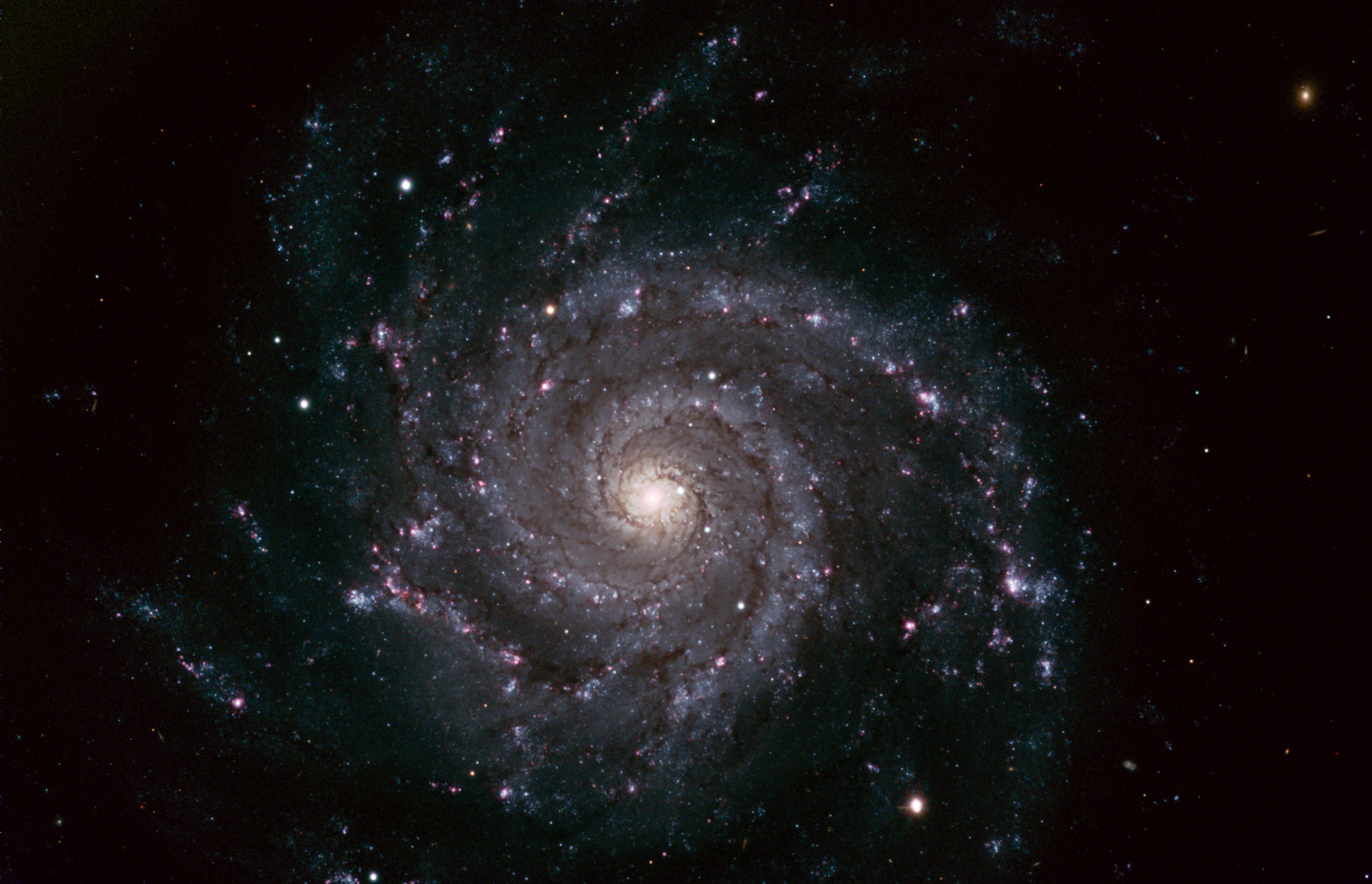
Image of M74 Galaxy obtained using PF-QHY on the WHT and R, G, B and Hα filters. Credit: Darío González Picos, Lara Monteagudo, Chris Benn and Ovidiu Vaduvescu. Large format: JPG. |
The on-sky commissioning of WEAVE will begin after integration of the instrument. In this phase, all the subsystems of the instrument are integrated together and tested as a system to verify that all the technical requirements are met. It will last 2 to 3 months and will be followed by science-verification (SV) observations. After SV, ING (Isaac Newton group of Telescopes) will commence routine survey and open-time observing. Regarding the latter, the first allocations, from the International Time Programme (ITP), have already been awarded, and an announcement of opportunity for open time will be issued once the commissioning of WEAVE is finished.
During the past few years, the WEAVE Science Team have been preparing the wide-ranging science plans that cover various fields of Galactic and extragalactic astronomy. There are currently eight independent WEAVE surveys planned, each with their own dedicated Science Teams, that will use up to 70% of the telescope’s allotted time during 5 years. WEAVE, with its MOS and IFU modes, will also be accessible to the wider astronomical community through open competition outside of this time. The planned WEAVE Surveys are the following:
WEAVE’s science team have all scientific programmes ready and they are preparing the observations for the eight surveys that will take place in the 5 years that the project is estimated to last. Several teams from the Institute of Cosmos Sciences of the University of Barcelona are involved in these surveys:
The Galactic Archaeology survey aims to complement the data obtained by Gaia by providing accurate radial velocities and elemental abundances for stars with V magnitude between 17 and 20 (for radial velocities) or between 12 and 17 (for elemental abundances). Some of its main science goals include: enabling the determination of fundamental Galactic parameters, investigating the origin of the thick stellar disk, identifying/characterising streams of stars in the Galaxy’s halo, studying the substructure in the disk kinematics, or characterising Open Clusters by studying their formation and evolution and using them as Galactic tracers. In this survey, we have members working specially on the Galactic disk component, such as Teresa Antoja -disk component leader-, Mercè Romero-Gómez -Survey Working Group member-, Francesca Figueras, Friedrich Anders, Eduard Masana, and in the Open Clusters component, such as Lola Balaguer-Núñez, Juan Carbajo-Hijarrubia, and Carme Jordi.
The SCIP-Stellar Circumstellar and Interstellar Physics survey will target the high-mass and young/old extremes of stellar evolution, along with the inter-stellar medium on the large scale, obtaining the spectra of objects such as OBA stars, Young Stellar Objects, Red Super Giants, Cepheids or stellar remnants and their ejecta. This will allow WEAVE to address questions regarding the relations between star formation, evolution, and the inter-stellar medium seen in both emission and absorption, as well as Galactic disk structure as seen through the young component. This survey counts with the participation of researcher Maria Monguió (Survey Woking Group member) and Francesca Figueras.
The WEAVE-QSO survey will collect observations from the Lyman-alpha forest – a ‘forest’ of absorption lines seen along the lined of sight to distant Quasi-Stellar-Objects (QSOs) that are caused by the intervening intergalactic medium (IGM) and circumgalactic medium (CGM). The WEAVE-QSOs survey will provide IGM/CGM temperature, density, 3-D mapping and clustering. Clustering information includes the measurement of Baryonic Acoustic Oscillations, a 'standard ruler' enabling to probe the accelerating expansion of the Universe and thus gain a better understanding of 'dark energy'. They will tackle questions such as ‘How did the accelerated expansion of the universe emerge?’ This survey counts with the participation of researcher Jordi Miralda.
Test of lepton universality using B0→KS0l+l- and B+→K*+l+l- decays.


Today at the CERN seminar and at the Rencontres de Blois the LHCb Collaboration presented new tests of lepton universality, one of the basic principles of the Standard Model (SM) of particle physics. This principle states that the SM treats the three charged leptons (electrons, muons and taus) identically, except for differences due to their different masses. The new measurements, while of limited statistical sensitivity, exhibit the same coherent pattern of deviations from lepton universality as seen in previous LHCb results.
In March 2021, the collaboration reported an evidence at 3.1 standard deviations (σ) for the breaking of lepton universality in a measurement of the ratio RK. The ratio RK describes how often a B+ meson decays to a charged kaon and either a positive and a negatively charge muon (K+μ+μ-) or a positron-electron pair (K+e+e-). These decays are extremely rare, occurring at a rate of only one in two million B+ meson decays. The decays involve the transformation of a beauty quark into a strange quark (b→s), a process that is highly suppressed in the Standard Model and can be affected by the existence of new particles, which could have masses too high to be produced directly at the Large Hadron Collider. The left graph shows Standard Model contributions involving γ, W+, and Z0 bosons. The right one shows a possible new physics contribution to the decay with a hypothetical leptoquark (LQ) which, unlike the Standard Model bosons, could have different interaction strengths with the different types of leptons.
Deviations at the level of 2.2-2.5 σ in a measurement of the ratio RK*0 were also reported in April 2017.
Both ratios exhibit a deficit of μ+μ- pairs with respect to e+e- pairs. Today’s results also report tests of lepton universality, using ratios RK and RK*. However, in this measurement, K and K* mesons with different electric charges have been used. Physicists call these newly measured decays the“isospin partners” of the previously measured decays. The new ratios are labelled RKS0 and RK*+.
LHCb has studied a number of other such ratios comparing decays with different leptons (l=e, μ, or τ leptons) in beauty particle decays (see R(D*), R(J/ψ) and R(pK)). These results revealed hints of deviations from lepton universality, none of which is significant enough to constitute an observation of new physics on its own. However, according to theorists who study possible extensions of the SM, these deviations combined suggest an interesting and coherent pattern, which could be evidence for physics beyond the SM.
The values of the RKS0 and RK*+ ratios are presented at the top of this article. These ratios correspond to the transitions B0→KS0l+l- and B+→K*+l+l-.

Figure 1. Quark diagrams for a B0→KS0l+l- decay.
The ratios are also presented in figure 2 for different regions of the dilepton invariant mass squared, q2. They are individually consistent with the SM at the 1.4 and 1.5σ level, their combination at the 2σ level (for experts: using a fit for a single Wilson coefficient). It is interesting to note that the central values exhibit the same coherent pattern of deviation as the other lepton universality tests performed by LHCb – the muon pairs are observed less frequently than the electron pairs. The image to the left lists the new measurements by LHCb, the most precise to date, of RKS0 and RK*+ ratios, and previous measurments by Belle.

Figure 2. RKS0 and RK*+ Ratios for different regions of the dilepton invariant mass squared, q2
The bottom left image above shows the KS0μ+μ- mass distribution and the bottom right image the KS0e+e- mass used to determine the RKS0 ratio. The top left image shows the KS0π+ μ+μ- mass distribution and the top right the KS0π+e+e- mass distribution used to determine the RK*+ ratio. Note that a K*+ meson decays into a KS0 and a π+ meson and note also a clear accumulation of events at the B0 or B+ mass.

The Institute of Cosmos Sciences of the University of Barcelona participates in this experiment with the researchers Carla Marín, Eugeni Graugés, Lluís Garrido, Ricardo Vázquez who have contributed to the development and optimisation of the electron reconstruction process, which is a crucial ingredient in the obtention of these measurements. We should also mention that the ICC-LHCb group counts with a new addition to their team, PhD Student Albert López, who will work on a similar Lepton Universality measurements as described in this news item with baryons. He will analyse the transition Λb0→pK-l+l-
Read more in the LHCb presentations at CERN and at Blois, and in the LHCb paper. You can also stay on the loop of the announcements of new results by following the experiment’s twitter account @LHCbExperiment.