Image

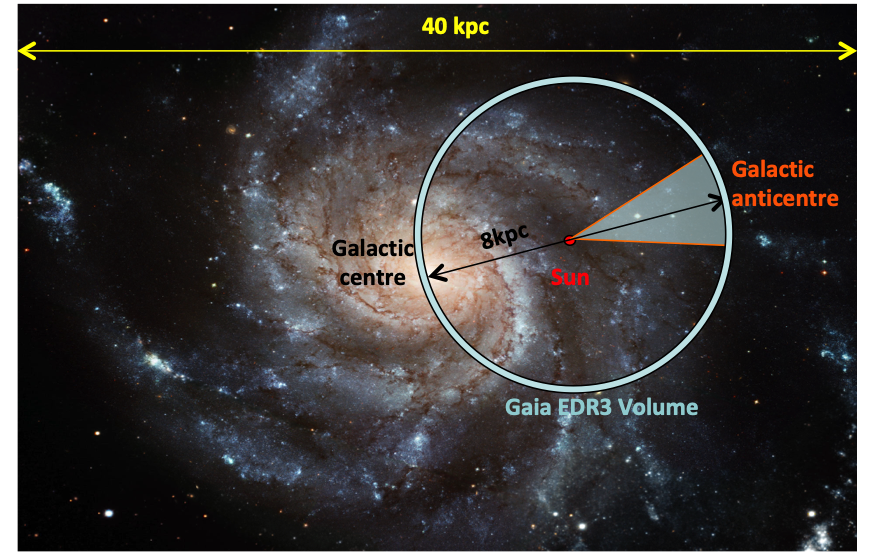
This study, published in Astronomy and Astrophysics journal, has used the kinematic data from the Gaia Second Data Release, a satellite of the European Space Agency, where in addition to the positions of 1.7 billion stars, includes data on the distance, motion and colour of more than 1.3 billion stars in the Milky Way and nearby galaxies. Researchers have been able to clearly observe the galactic anticentre where two structures in the galaxy's outer disk are located, called Anticenter Stream (ACS) and Galactic anticenter stellar structure (GASS, also known as Monoceros), which are the most prominent structures in the distant sky after the Magellanic Clouds and Sagittarius.
“The new data from the Gaia satellite show us in exquisite detail the disorder that reigns in the outermost parts of the Galaxy, opening the possibility of establishing the causal connection between these distant structures and the structures we observe near the Sun.”, explains the researcher Pau Ramos from the Institute of Cosmos Sciences of the University of Barcelona.
Researchers have been able to confirm that the two structures, ACS and GASS, must be part of the Milky Way disk. This conclusion involves continuing with these phenomena modelling and extracting all the information to build the theoretical framework.
The goal of the researchers is to form a coherent and unified image of the outer disk of the galaxy, to which the long-awaited Gaia Third Data Release will contribute. The improvement in the astrometric accuracy, as well as an increased number of stars observed, especially the faintest, and radial velocities will allow us to probe the galactic anticenter like never before and thus advance in the understanding of the history of the Milky Way. There are also other important catalogues in the field, such as SDSS-V, Subaru Prime Focus Spectrograph or WEAVE that will provide much more information about the region and will allow drawing a more accurate and clear picture of the outer disk of our galaxy.
The ICCUB team (UB-IEEC), led by Professor Carme Jordi and professors Xavier Luri and Francesca Figueras, from the Department of Quantum Physics and Astrophysics, has participated in the Gaia mission from the beginning. Their role was focused on the scientific and technological design of the project, the development of the data processing system and the production of simulated data.
Regarding the now presented data, the Barcelona team coordinates the group that has developed the archive of the mission. It is also responsible for running several key processes for processing the data that arrives daily from the satellite, the first step in obtaining results for scientific use such as those now published. The group is also responsible for the process of pairing the various observations of the same star, and it collaborates in the calibration of star photometry and is fully involved in the scientific exploitation of the data. Finally, the Catalan researchers have played an important role in the performance verification papers, articles that are published together with the data and which verify their quality. Specifically, they have led four of these articles and have played a significant part in much of the rest.
The ICCUB Gaia team (UB-IEEC), made up of about thirty scientists and engineers, was awarded the 2013 City of Barcelona Award for Experimental Sciences and Technology. It is part of the Gaia Data Processing and Analysis Consortium, made up of more than 400 people from around twenty European countries, and leads the creation of the archive of the mission. Some of its members are part of the Gaia Science Team (GST), the ESA scientific advisory body.
Article reference
P. Ramos, T. Antoja, C. Mateu, F. Anders, C.F.P. Laporte, J.A. Carballo-Bello, B. Famaey, R. Ibata. «The outer disc in shambles: blind detection of monoceros and the acs with gaia's astrometric sample». Astronomy & Astrophysics, February 2021.
Liquids are ubiquitous in Nature: from the water that we consume daily to superfluid helium which is a quantum liquid appearing at temperatures as low as only a few degrees above the absolute zero. A common feature of these vastly different liquids is being self-bound in free space in the form of droplets. Understanding from a microscopic perspective how a liquid is formed by adding particles one by one is a significant challenge.
Recently, a new type of quantum droplets has been experimentally observed in ultracold atomic systems. These ones are made of alkaline atoms which are cooled down to extremely low temperatures of the order of nanokelvins. The main peculiarity of these systems is that they are the most dilute liquids ever experimentally observed. An extraordinary experimental control over the system opens the possibility of unraveling the mechanism leading to the formation of quantum droplets.
In a recent article published in Physical Review Letters, UB researchers, Ivan Morera and the late Prof. Artur Polls led by Prof. Bruno Juliá-Díaz, in collaboration with Prof. Grigori Astrakharchik from UPC, present a microscopic theory of lattice quantum droplets which explains their formation.
The team of researchers has shown that the formation of the quantum droplet can be explained in terms of effective interactions between dimers (bound states of two particles). Moreover, by solving the four-body problem they have shown that tetramers (bound states of four particles) can appear and they can be interpreted as simple bound states of two dimers.
The properties of these tetramers already coincide with the ones of large quantum droplets which indicates that many of the feature properties of the many-body liquid are contained in the tetramer. They also discussed the possibility of observing these strongly correlated droplets in dipolar bosons or bosonic mixtures in optical lattices.
More information:
Coordinated by ICFO, QuantumCAT includes leading research institutions in Catalonia, such as ICFO itself, the Autonomous University of Barcelona (UAB), the Polytechnic University of Catalonia · BarcelonaTech (UPC), the Institute of Cosmos Sciences of the University of Barcelona (ICC-UB), the Fundació i2CAT, the Barcelona Supercomputing Center (BSC), the Catalan Institute of Nanoscience and Nanotechnology (ICN2), and together with the Institute of High Energy Physics (IFAE) and the National Center of Microelectronics (CNM) as collaborators.
QuantumCAT receives the support of the Secretaria d'Universitats i Recerca del Departament d'Empresa i Coneixement of the Government of Catalonia and FEDER (001-P-001644). It is part of RIS3CAT, an initiative of the Government of Catalonia. RIS3CAT aims to develop and promote the industrial vision of Catalonia, with an open, competitive and sustainable economy, combining talent, creativity, and a diversified business ecosystem in addition to its own system of research of excellence, in the framework of a dynamic, enterprising and inclusive society. Within the region, there are multinational and local companies, which are considered international leaders and experts in emerging technology sectors.
The Institute of Cosmos Sciences participates in the quantum computing and simulation parts through our researchers Montserrat Guilleumas, Bruno Julià, Sofyan Iblisdir, María Moreno, Ricardo Mayol and Luca Tagliacozzo.
About one hundred years ago, scientists of the time tried to explore and understand the nature and behaviour of the elements that make up the world that is governed by the laws of quantum physics. Nowadays and with a robust and solid understanding of how that world works, current generations of scientists and engineers are searching for new methods to control and manipulate these elements to create a new range of applications for digital technologies. Quantum technologies based on unique properties of quantum physics offer unprecedented capabilities for modern applications of the information society.
Continuously adapting and changing to new situations, societies are preparing for the emergence of novel disruptive technologies that will soon signify a paradigm shift, specifically in the fields of security and privacy of communications via the Internet. Governments and industries around the world are putting their efforts and beliefs in this scientific-technological trend, and are therefore allocating considerable resources to make it a reality.
Comprised by internationally renowned scientists with extensive experience in quantum technologies, as well as a growing network of companies interested in this field, Catalonia has joined this new wave, establishing a Quantum Technologies Hub in the region called QuantumCAT.
QuantumCAT aims to promote technology transfer and innovation projects with an industrial and social impact in the short and medium-term. To achieve this, it aims to focus on transferring discoveries made in research laboratories to the market, using industrially viable implementations and applications, addressing three main problems. Firstly, to promote specific and high-potential laboratory technologies and to encourage their industrial deployment and implementation through collaborative and cooperative research efforts. Secondly, to facilitate the dissemination of successful development and innovation strategies at the community level. And thirdly, to conduct outreach actions, such as networking events and workshops, aimed at academic and industry audiences, to discuss experiences and collaborations, as well as share knowledge among the community regarding success stories and use-case studies.
As Dr. Morgan Mitchell, scientific coordinator of the initiative, comments, "This is a very exciting time for quantum technologies. In particular, the support that QuantumCAT is receiving from the community in Catalonia proves it. Those who have been working in this field for many years are delighted to see that policymakers are supporting the acceleration of these technologies towards the development of innovative and relevant applications for industry and society”.
The Hub will coordinate activities in various technological areas, mainly in: quantum communication and cybersecurity, quantum computing and simulation, quantum artificial intelligence, and quantum metrology. Developments in these fields will seek to facilitate the transformation of scientific concepts into tangible implementations for industry and citizenship in general, through applications ranging from secure Internet communications to ultra-high precision images for the management of natural resources as well as medicine.
Dr. Lluis Torner, Director of ICFO, emphasizes the strategic importance of the field by mentioning that “it was already known that the potential of quantum technologies in the medium term is enormous; what the COVID episode has shown is that, with the exponential growth of security needs and the preservation of privacy in communications that will remain with us forever in the context of the digitalization of industry, society and economy in general, it is urgent to implement it for companies, entities, and citizens who manage sensitive data, such as medical, economic or simply private information”.
More information
Coordinated by ICFO, QuantumCAT includes leading research institutions in Catalonia, such as ICFO itself, the Autonomous University of Barcelona (UAB), the Polytechnic University of Catalonia · BarcelonaTech (UPC), the Institute of Cosmos Sciences of the University of Barcelona (ICC-UB), the Fundació i2CAT, the Barcelona Supercomputing Center (BSC), the Catalan Institute of Nanoscience and Nanotechnology (ICN2), and together with the Institute of High Energy Physics (IFAE) and the National Center of Microelectronics (CNM) as collaborators.
QuantumCAT receives the support of the Secretaria d'Universitats i Recerca del Departament d'Empresa i Coneixement of the Government of Catalonia and FEDER (001-P-001644). It is part of RIS3CAT, an initiative of the Government of Catalonia. RIS3CAT aims to develop and promote the industrial vision of Catalonia, with an open, competitive and sustainable economy, combining talent, creativity, and a diversified business ecosystem in addition to its own system of research of excellence, in the framework of a dynamic, enterprising and inclusive society. Within the region, there are multinational and local companies, which are considered international leaders and experts in emerging technology sectors.
These new methods for producing robust topological order in atomic systems could facilitate fault-tolerant quantum computation and quantum simulation of high-energy physics.
At low temperatures, certain quantum systems evade the standard forms of order that give rise to usual phases of matter, such as crystalline solids or magnetic materials. Instead, strong quantum correlations between their constituent particles lead to configurations characterized by topological order, where distinct global properties are protected against local perturbations. This allows one to encode information in a non-local manner, providing a promising avenue to fault-tolerant quantum computation. However, preparing such quantum states is a challenging experimental task, requiring a precise fine-tuning of the system’s parameters.
In a recent paper published in Physical Review X, ICFO researcher Daniel Gonzalez, led by ICREA Prof. at ICFO Maciej Lewenstein, in collaboration with Luca Tagliacozzo from ICCUB, and also led by Alejandro Bermudez from the Universidad Complutense of Madrid, identify two mechanisms that could allow topological order to be found under more relaxed conditions in near-term atomic experiments.
In this work, they study a gauge theory model whose main building blocks have already been implemented using ultracold atoms in optical lattices. The use of gauge theories, characterized by local symmetries, is ubiquitous in theoretical physics, ranging from the description of fundamental particles such as quarks to the physics behind high-temperature superconductors.
In their model the researcher first show how an internal magnetic field is spontaneously generated, bringing about topological order to the system. Then, they identify a mechanism that allows these effects to survive under arbitrary, large fluctuations. This mechanism also leads to the presence of deconfined quasiparticles in the spectrum, another interesting but yet partially unexplored feature of gauge theories connected to open questions in particle physics.
The results of the study indicate the existence of novel methods to experimentally address strongly-correlated topological effects, which are relevant to condensed matter and high-energy physics, using controllable atomic systems.
Read more at Physical Review X https://journals.aps.org/prx/abstract/10.1103/PhysRevX.10.041007
How a city on Mars would look like? How would trade work? How would the urban population evolve?
The SONet team imagined the Mars city NÜWA, detailed in a comprehensive project that includes scientific, engineering, architectural, economic and social aspects. The project proposes not only a feasible urban design but also a socio-economic development plan, as well as high-level descriptions of the industry, infrastructure, generation and distribution of energy and services needed to make it a reality.
The team forged the project during online meetings in April, May and June 2020 amid the confinement due to the COVID-19 pandemic. The proposal consists of a 20-page long report with a conceptual design combining a wide range of aspects, from space exploration to sustainability. The city, called NÜWA in honour of the Chinese goddess who created humanity, symbolises the beginning of a new era of our civilisation on Mars and the protection that must be ensured in such an inhospitable world.
"The proposal is an effort to combine many disciplines in a way that is not usually done in space projects" explains Guillem Anglada-Escudé, researcher of ICE and the team’s coordinator. "In addition to scientists and engineers, we wanted from the very beginning to incorporate experts in other disciplines and from outside the academic sector."
Our astronomer and ICREA professor Jordi Miralda is one of the researchers of the SONet team. "Scientists from different disciplines, especially those of us who study the Universe and the physical principles governing it, should help disseminate the technological and scientific knowledge that will allow humanity to start a new era of expansion of our inhabited territory to space", he says. "Mars offers a great scenario for the first chapter of this expansion to the Universe".
"Reaching the final is already a great success for us", explains Miquel Sureda, from ESEIAAT. "We hope the competition will provide us with the visibility we need to gather support and develop concepts related to both space and sustainability, and the necessary transformation of the productive system that we must also face here on Earth.”
The proposal also studies issues such as the use and abuse of plastics, construction and material solutions that minimise the intensive use of energy and total recyclability. "Performing these exercises also makes us realise the great dependence we have on what our planet gives us in return for nothing”, the co-author of the initiative and director of the Institute of Energy Techniques, Ignasi Casanova, explains. "For example, the production of food requires a huge amount of energy, which comes from the Sun, but which involves the use of large areas of arable land. It is therefore one of the most aggressive human activities towards the terrestrial ecosystem.”
The presentation will take place on Saturday, 17 October 2020 at 22.00 (CEST), via 'Facebook Live'. Viewers must register for free to the 23rd Annual International Mars Society Convention, here https://www.eventbrite.com/e/2020-mars-society-international-teleconvention-tickets-102005870304
More information
Institute of Space Studies of Catalonia (IEEC)
The Sustainable Offworld Network (SONet)
B. Fundamental Physics and Astrophysics from Gravitational Waves
Fundamental physics and stellar/dynamical origin of black hole and neutron star mergers, analysis of gravitational wave events.
C. Strongly Coupled Matter
Behavior of dense, strongly coupled matter in the early universe and in neutron stars.
D. Beyond the Standard Model: New Particles and Dark Matter
Flavor physics, particle physics beyond the standard model, axion detection experiments (IAXO and RADES), axion physics as dark matter candidates.
E. Structure and Evolution of the Milky Way Galaxy through Gaia
Dynamics and structure of the Milky Way galaxy from Gaia data and other observations.
F. Quantum Computation and Simulation
Physics of quantum computation and simulation of quantum systems.
A team of international researchers reports on new advances in the understanding of fractional angular momentum and anyon statistics of impurities in Laughlin liquids
While in a three-dimensional world, all particles must be either fermions or bosons, it is known that in fewer dimensions, the existence of particles with intermediate quantum statistics, known as anyons, is possible. Such fascinating objects are strongly believed to exist as emerging quasiparticles in fractional quantum Hall systems, but despite great efforts, experimental evidence of anyons has remained very limited. Since quantum statistics is defined through the behaviour of the phase of the wave function, when two identical particles are exchanged, early attempts of anyon detection have been based on interferometric measurements using Fabry-Perot interferometry or beamsplitter experiments.
So far, there have been many efforts to improve the experimental evidence of anyons by searching for ways to study the FQH effect and understand its underlying physics in highly controllable quantum systems such as cold atoms or photonic quantum simulators. Some studies have shown that light-matter interactions can create and trap fractional quasiparticles in atomic gases or electronic systems and measure, through time-of-flight imaging, signatures of fractional statistics carried by the total angular momentum of a fractional quantum Hall system.
In a recent study published in Physical Review Letters, ICFO researchers Tobias Grass, Niccolo Baldelli, Utso Bhattacharya and Maciej Lewenstein, in collaboration with ICCUB researcher Bruno Julia-Díaz, describe a new approach towards anyon detection, which is a crucial element for increasing our knowledge of the exotic quantum matter.
Contrary to earlier detection schemes, the study authored by the researchers opens up a new possibility which requires neither particle exchange nor interferometry. Instead, the authors suggest tracing the behaviour of the anyons by binding impurity particles to them.
Specifically, the average angular momentum of a single impurity is shown to take characteristic values that are possibly fractional. For a system of multiple impurities, the total angular momentum should then depend on how these effective single-impurity levels are filled. Strikingly, the value obtained by the authors corresponds neither to the filling of a Fermi sea nor to the condensation of a bosonic mode. Instead, the impurity angular momentum interpolates between these limiting cases, and the fractional statistical parameter of the anyons can be straightaway inferred from this interpolation.
Their detection scheme only requires density measurements and might apply to Abelian quantum Hall phases in electronic materials as well as in photonic or atomic quantum simulators. The authors discuss also possible generalizations towards non-Abelian anyons. Since the impurities realize a non-interacting gas of anyons, their work also poses the possibility of studying the intricate thermodynamics of anyonic systems.
----
Read the article: T. Graß, B. Juliá-Díaz, N. Baldelli, U. Bhattacharya and M. Lewenstein. Fractional Angular Momentum and Anyon Statistics of Impurities in Laughlin Liquids. Phys. Rev. Lett. 125, 136801, 21 September 2020.Links:
Quantum Optics Theory group at ICFO
Quantum Technologies group at ICCUB
The Einstein Telescope (ET) is the most ambitious project for a future terrestrial observatory for gravitational waves (GWs). The conceptual design of this pioneering third-generation observatory has been supported by a grant of the European Commission, and now an international consortium has officially submitted the proposal for the realisation of such an infrastructure in the 2021 update of the European Strategic Forum for Research Infrastructures (ESFRI) roadmap.
The consortium is formed by 40 research institutions and universities all across Europe, including 8 Spanish, and several European countries, led by Italy with the political support of Belgium, Poland, Spain and The Netherlands. Its transnational headquarters are established at the European Gravitational Observatory (EGO) in Italy.
The Era of Gravitational Waves Astronomy
The remarkable scientific achievements of Advanced Virgo (in Europe) and Advanced LIGO (in the USA) in the last 5 years initiated the era of Gravitational Waves astronomy. The adventure began with the first direct detection of gravitational waves in September 2015 and continued in August 2017 when the two observatories observed gravitational waves emitted by two merging neutron stars. Simultaneously, signals of this event were observed with a variety of electromagnetic telescopes —on the ground and in space— over the entire observable wavelength range —from radio waves to gamma rays—. This marked the beginning of the era of multi-messenger astronomy with gravitational waves. Recently, the collaboration unveiled the existence of an extraordinarily massive merging binary system, the most massive black hole ever detected with gravitational waves.
Now, scientists propose the creation of a new observatory capable of observing GWs with sensitivity at least one order of magnitude better than the current detectors (the so-called second generation). The Einstein Telescope will be located in new infrastructure and will apply technologies that are dramatically improved over the current ones. It will enable scientists to detect any merge of two intermediate-mass black holes in the entire universe and thus contribute to the understanding of its evolution. This will shed new light on the Dark Universe and will clarify the roles of dark energy and dark matter in the structure of the cosmos. ET will explore the physics of black holes and will detect thousands of coalescences of neutron stars, improving our understanding of the behaviour of matter under such extreme conditions of density and pressure. Also, we will have a chance to explore the nuclear physics underlying the supernova explosions of the stars.
The Einstein Telescope has aroused great interest in the Spanish scientific community involved in gravitational waves, which includes all the centres that currently participate in ground-based (LIGO, Virgo and KAGRA) and space programs (LISA). Spanish researchers have contributed significantly to the development of the ET physics program, as well as to the preparation of its technical design report.
Our Institute joined the Virgo collaboration in July 2018, becoming a full member of Virgo in 2019. The ICCUB's Virgo team, led by researcher Jordi Portell, contributes to the electronics and instrumentation upgrades of Virgo and to improvements in the data analysis techniques. They also contribute to the review of the overall computing model, the software management and the data handling approach, aiming at efficient use of the computing facilities. These contributions are possible thanks to their expertise in other international projects such as the LHCb detector at CERN and ESA's astrometric satellite Gaia.
Two sites for the development of the ET infrastructure are currently being evaluated: The Euregio Meuse-Rhine, at the borders of Belgium, Germany and the Netherlands; and Sardinia, in Italy. It is hoped that a companion project in the US, Cosmic Explorer, will follow. With a successful ESFRI proposal, the project will enter its preparatory phase, which foresees the beginning of construction in 2026 intending to start observations in 2035.
More information
List of Spanish Institutions that initially supported the ET ESFRI initiative: Institute of Cosmos Sciences (ICCUB), Institute of Space Sciences (ICE-CSIC), ALBA Synchrotron, Barcelona Supercomputing Center (BSC), Canfranc UndergroundLaboratory (LSC), Research Centre for Energy, Environment and Technology (CIEMAT), Spanish National Research Council (CSIC), Institute of Structure of Matter (IEM), Institute of High Energy Physics (IFAE), Institute of Corpuscular Physics (IFIC-CSIC), Institute of Theoretical Physics (IFT-CSIC), Port d'informació Científica (PIC), RedIris, University of Alicante(UA), Autonomous University of Madrid (UAM), University of the Balearic Islands (UIB), University of Cádiz (UC), University of Murcia (UMU), University of the Basque Country (UPV-EHU), Polytechnic University of Madrid (UPM), University of Salamanca (USAL), University of Santiago de Compostela (USC) and University of Valencia (UV). The candidacy was also supported by the Spanish Society of Relativity and Gravitation (SEGRE).
Links
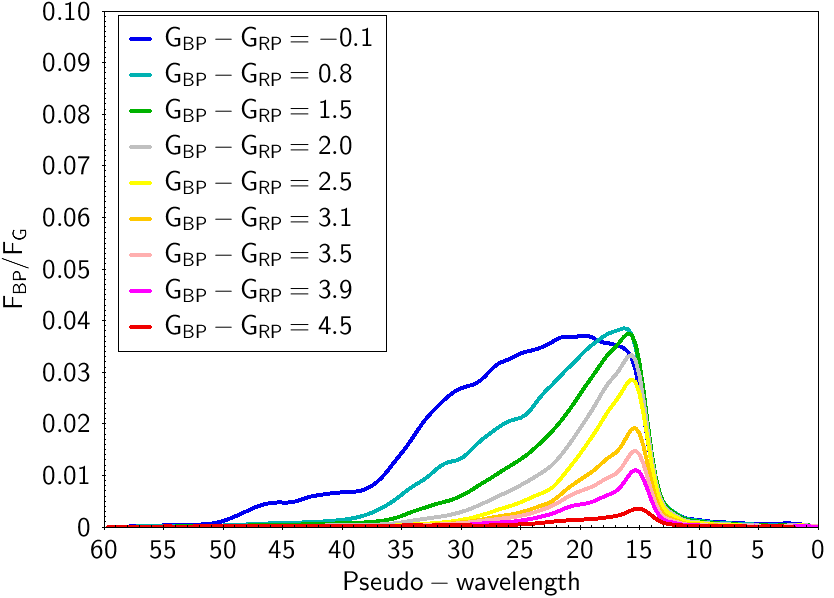
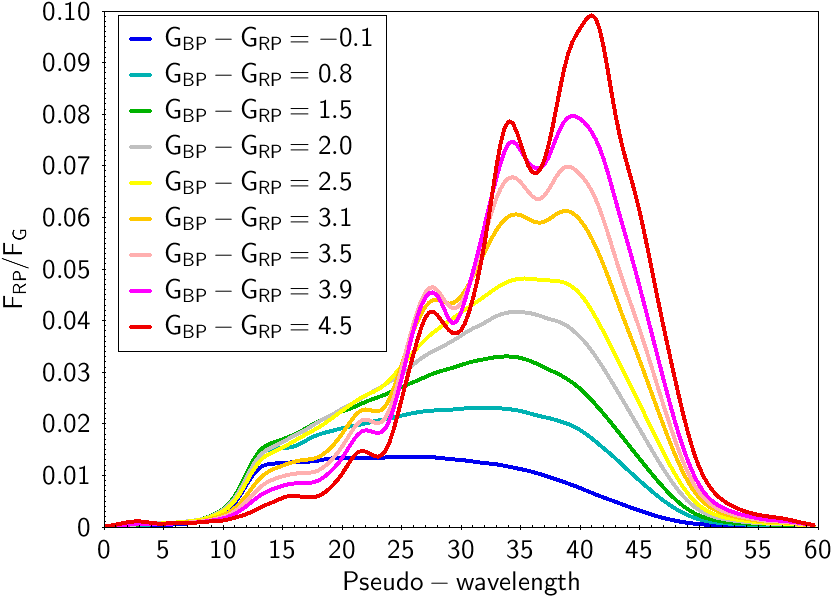
Figure 1: Mean and normalised spectra derived for a set of particular sources with different GBP - GRP colours taken as examples. The left panel shows the spectra derived from the Blue Photometer instrument, the right panel the mean spectra from the Red Photometer. Image credit: ESA/Gaia/DPAC
Gaia has proven to be a powerful tool providing very precise astrometry and photometry in the first releases of the mission (see Gaia DR2 and Gaia DR1). The third release and beyond (find here the current release scenario planning) will include some calibrated spectrophotometric data.
Spectrophotometry in Gaia is obtained using two prisms. Each of these prisms is able to divide the incoming light of the observed source into the different colours of the rainbow (similarly to what is represented in the iconic image of the cover of the Pink Floyd’s album “The dark side of the Moon”). One of these prisms is designed to detect blue light, called Blue Photometer or BP, covering a wavelength range from 330 to 680 nm. The second prism is, instead, designed for redder light, called Red Photometer or RP, covering the wavelength range from 640 to 1100 nm.
When the final Gaia catalogue will be available, it will constitute the most complete and homogeneous spectrophotometric catalogue of sources, containing more than one billion objects with homogeneous spectra obtained with the same instrument all across the sky.
This large catalogue of spectrophotometric data will be very useful to extract the astrophysical information for each source. In the case of stars, the BP and RP spectra provide temperatures, surface gravity, chemical composition and interstellar absorption. For galaxies and quasars, BP and RP spectra allow deriving the redshift. For asteroids one can determine their composition and types.
Right after the launch of the Gaia space telescope, and before starting the scientific operations, several tests were performed to assure the health of the payload. At that time, some raw observations obtained with the BP and RP spectrophotometers were published (see this image of the week of June 2014). Those spectra were uncalibrated single observations. Since then, we have accumulated observations in BP and RP for each source in the sky.
Before its publication in the Gaia catalogue, the team in charge of the photometric calibration in Gaia (Coordination Unit 5 or CU5) has calibrated the two spectrophotometers and combined the different observations of the same source to build a mean spectrum representing the average of all transits. These mean spectra will suffer less noise effects than every individual observation, providing more information than a single transit. The figures included here show some examples of these mean calibrated spectra derived by CU5.
In the absence of extinction, the colour of the stars is related with their temperature. Hot stars are bluer than cooler ones. Thus, hot stars have most of their flux in the BP instrument and cooler ones, instead, are brighter in RP. This is a gradual effect and intermediate temperatures will have a more balanced contribution in both wavelength ranges. This can be clearly seen in Figure 1, showing selected examples of the first calibrated mean BP and RP spectra for stars having different observed colours.
By integrating the spectra, one can derive two associated magnitudes, one for the BP and one for the RP instrument. We call these two magnitudes GBP and GRP, respectively. Taking the difference between these two magnitudes gives an indication of how blue or red a source is. Blue (hotter) stars have smaller GBP - GRP values than red (cooler) stars. In Gaia, there is also a third (and more precise) magnitude, obtained with the astrometric detectors in white light devoted to the astrometric measurements, called G, which provides a better estimate of the global apparent brightness of the star. The mean spectra in Figure 1 have been normalised by the total flux in G. The GBP - GRP colour of all sources is also given in the legend of the plot.
The abscissa in all plots is given in pseudo-wavelength. This is an internal wavelength scale, close to the actual sampling of the spectra, representing different absolute wavelenghts in BP and RP. Conversion to the absolute wavelength physical units will be provided with the released spectra (expected in Gaia DR3).
|
|
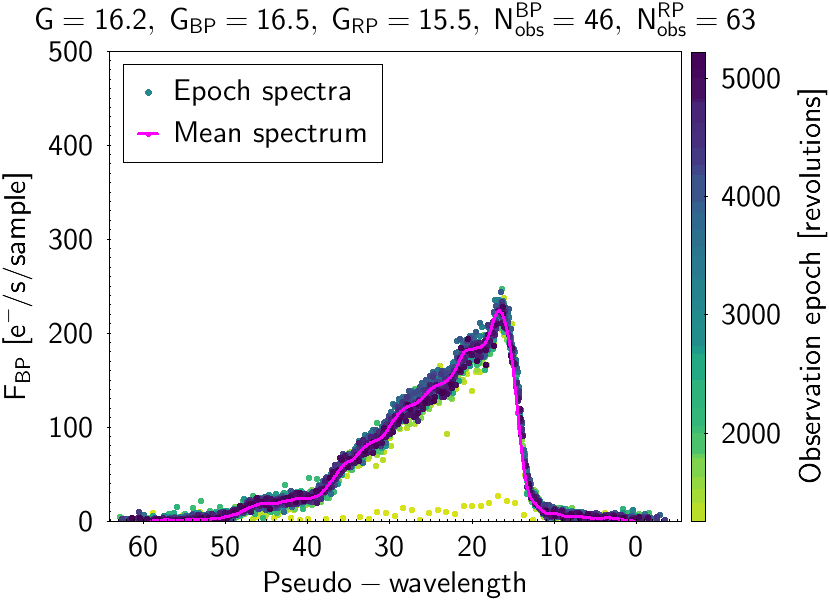
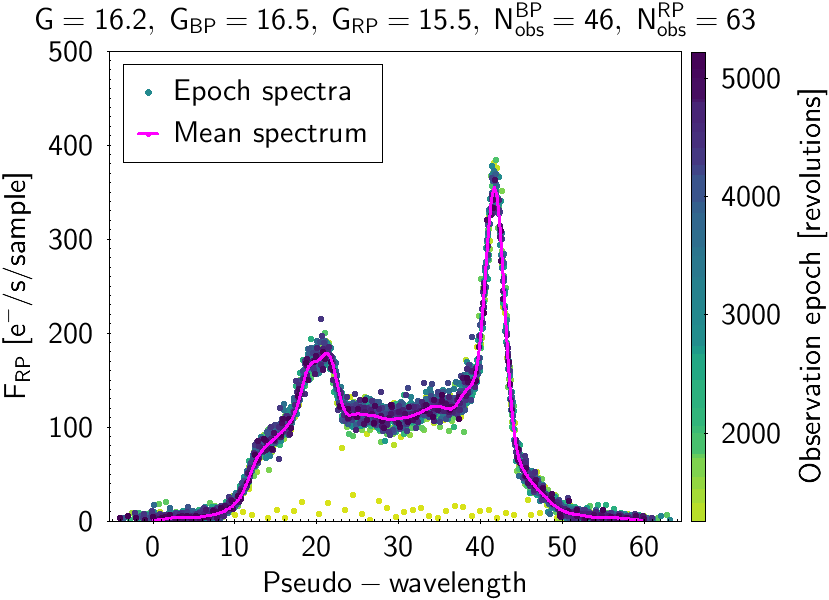
Figure 2. Epoch and mean spectra for an extragalactic source used in Gaia DR2 to derive the Gaia Celestial Reference Frame (Gaia-CRF). The titles in each plot include the magnitudes in the astrometric field (G) and each spectrophotometric instrument (GBP and GRP) and also the number of individual observations in each instrument Nobs. Image credit: ESA/Gaia/DPAC
Sources in Figure 1 have a magnitude of about G=13 mag. The signal to noise ratio observed at the maximum flux of the spectra at this magnitude is about 600 for BP and 1000 for RP.
Gaia also observes point-like sources other than stars. For example, extragalactic sources (far-away quasars) are used to establish the astrometric reference frame (Gaia Celestial Reference Frame, Gaia-CRF). For those sources, the spectral energy distribution in BP and RP differs drastically from those of stellar sources. Some of these quasars can have strong emission lines. Two of these type of sources are plotted in Figures 2 and 3.
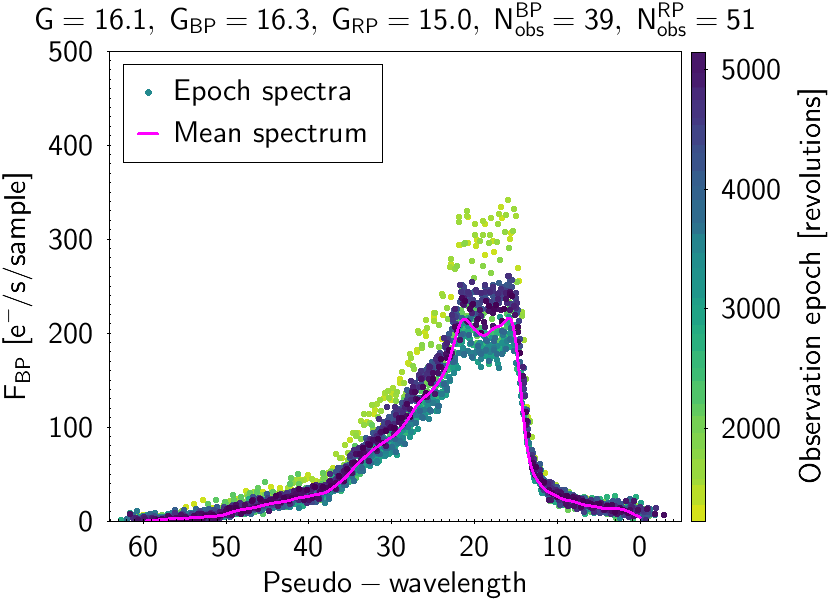 | 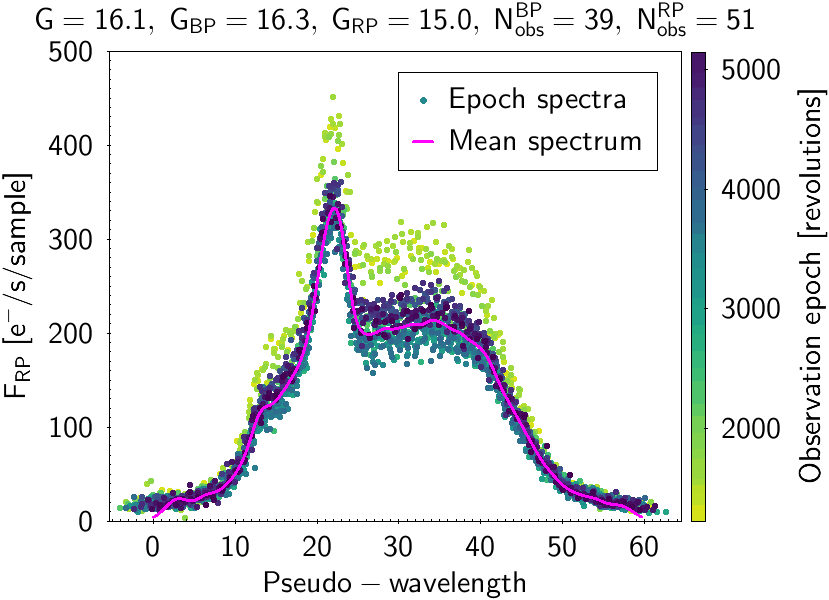 |
Figure 3. The same as in Figure 2 but for another quasar. The flux-level variations between observations made at different epochs indicate the variable nature of the source. Image credit: ESA/Gaia/DPAC
These plots show both mean and epoch spectra overplotted, illustrating the process to build the mean spectra from different epoch observations. The different epochs in Gaia are measured in number of six-hour revolutions done by the satellite while surveying the sky. The source in Figure 2 has a very low flux level in one of its transits. The photometric processing is sufficiently robust to consider this measurement as an outlier, thereby not producing a deviating mean spectrum by including this bad observation. The source plotted in Figure 3 is a variable one showing a changing flux level at different epochs. The mean spectrum built is a weighted average of all the epoch observations. For variable sources, this means that although the mean spectra may not be representative of any particular epoch, they are useful to provide a hint of the average behaviour and mean characteristics of the source.
Credits: ESA/Gaia/DPAC, Coordination Unit 5, Josep Manel Carrasco, Francesca De Angeli, Dafydd Wyn Evans, Carme Jordi, Michael Weiler
The Radial Velocity Experiment RAVE is a spectroscopic survey of stars in the southern hemisphere. As the first stellar survey using a multi-object spectrograph, it is ground-breaking in the field of Galactic Archaeology and has facilitated the activity of other ground-based surveys such as WEAVE, and influenced space missions such as Gaia.
For more than a decade RAVE, one of the first and largest systematic spectroscopic surveys, studied the motion of Milky Way stars. The RAVE collaboration now published the results for over half a million observations in its 6th and final data release. RAVE succeeded in measuring the velocities, temperatures, compositions and distances for different types of stars. The unique database enables scientists to systematically disentangle the structure and evolution history of our Galaxy.
RAVE was designed to get a representative census of the movements and the atmospheric properties of stars in the wider neighbourhood of the Sun. Using spectroscopy, the light of a star is decomposed into its rainbow colours. By analysing the spectra, the radial velocity of a star – the movement of the stars in the direction of the observer's view, can be determined. Furthermore, stellar spectra also enable scientists to determine stellar parameters like temperatures, surface gravities, and composition. To trace the structure and shape of our galaxy, RAVE successfully measured 518,387 spectra for 451,783 Milky Way stars.
Astronomers are not only used to think in long time scales – their projects also are often many-year endeavours. RAVE observed the sky for almost every clear night between 2003 and 2013 at the 1.2-metre UK Schmidt telescope of the Anglo-Australian Observatory in Siding Spring, Australia. RAVE utilized a dedicated fibre-optical setup to simultaneously take spectra of up to 150 stars in a single observation. Only with this massive multiplexing, such a large number of targets was achievable – the largest spectroscopic survey before RAVE featured only some 14000 targets. In this way, the survey obtained a representative sample of the stars around our Sun that are located roughly in a volume 15000 light-years across.
15 years of observations
Over the past 15 years, an increasing number of stars and refined data products have been released. The final RAVE data release not only provides for the first time the spectra of all-stars in the RAVE sample; the stars were also matched with stars from the DR2 catalogue of the satellite mission Gaia. Thanks to the exquisite distances and proper motions measured by Gaia, considerably improved stellar temperatures, surface gravities and the chemical composition of the stellar atmospheres could be derived.
“RAVE allowed us to study the three-dimensional velocity distribution of the Galactic disc”, says ICCUB astronomer Teresa Antoja. She worked for three years in the scientific analysis of RAVE, during her postdoctoral stay at the University of Groningen. She also supervised a thesis on the dynamics of the galactic disc, using RAVE simulations and data.
Researchers already knew about several large groups of stars moving together through the solar environment. Initially, some of these groups were thought to share a common birthplace, but this was incompatible with the ages and chemical abundances measured for these stars. The RAVE data helped to reinforce another hypothesis. “Dynamical streams and comoving groups of stars are among the most interesting objects that we observed with RAVE”, Antoja explains, “Thanks to the RAVE data we could see that far away from the Sun similar streams exist and that their motions change with their position in the Galaxy. We could find that the way these streams change is compatible with the gravitational effects of the Galaxy’s bar, which influences the motions of stars not only in the inner galaxy but also in the solar neighbourhood”. Recently, astronomers have seen that the stellar streams might also be caused by external galaxies approaching the Milky Way, or by the spiral arms of our galaxy, so they continue to gather data from distant stars to solve the puzzle.
Some of the key results of RAVE also include; the determination of the minimum speed needed for a star to escape the gravitational pull of the Milky Way; the confirmation that dark matter, an invisible component of the Universe of yet unknown nature, dominates the mass of our Galaxy. With RAVE it could be shown that the Milky Way disk is asymmetric and that the chemical element abundances of the observed stars hold important clues to the chemical composition of the interstellar medium, traced by stars of different ages and metallicities.
What comes next?
After RAVE, other surveys such as WEAVE or SDSS will continue mapping the sky from the Earth. Since it first launched in 2013, the ESA's Gaia mission has been covering not only the southern hemisphere but the full sky. Until now, it has produced two data releases (DR1 and DR2), and the third one will be published in 2021. This third data release will include millions of spectra from the Gaia/RVSinstrument that will be very similar to the ones obtained by RAVE.
The RAVE collaboration consists of researchers from over 20 institutions around the world and is coordinated by the Leibniz-Institut für Astrophysik Potsdam AIP. More than 100 refereed scientific articles based on RAVE data were published since the first data release.
Media gallery and videos at RAVE Survey
RAVE data release at the Astrophysical Journal
Related RAVE articles
Antoja T., et al. 2014. Constraints on the Galactic bar from the Hercules stream as traced with RAVE across the Galaxy
Antoja T., et al. 2012. Kinematic groups beyond the solar neighbourhood with RAVE