Image

JORDI TORRA ROCA
Barcelona, February 26th, 2019
A doctor in physics from the University of Barcelona (1984) and a professor of the Department of Quantum Physics and Astrophysics of our university, Jordi Torra Roca has focused his research career on the study of the structure, formation and evolution of our galaxy, the Milky Way. He was one of the European leaders in the development of astrometry from space. He headed Spanish participation in the Hipparcos astrometric mission of the European Space Agency (ESA) in the 1980s, and in the Gaia mission since 1997, through a satellite launched in 2013 which is still in operation. Without a doubt, Jordi had a more prominent role in the Gaia mission. Gaia is one of the great missions of ESA that maintains world leadership in the field of astrometry from space and which, due to its already demonstrated capabilities, is revolutionary in all areas of astrophysics now and will continue to be so in the next decades. Jordi Torra led with excellence the Spanish group involved in the mission. More than fifty professionals have been trained in the last 20 years in the Gaia team of the UB. This team is currently formed by about 30 astrophysicists and engineers working side by side, as he argued, to address the scientific and technological challenges posed by these major international projects at the forefront of research and technology. Jordi Torra also participated in other space missions such as the optical camera of the OMC @ INTEGRAL satellite, the SMART-2 mission and, more recently, the definition of new ESA astrometric missions such as NEAT, THEIA and GaiaNIR.
Passionate about astronomical observation and with extensive experience in the use of telescopes on the ground, he participated in the development of new instrumentation for the Gran Telescopio de Canarias and was one of the promoters for the creation of the Montsec Astronomical Observatory and the Centre for Observing the Universe (Àger), the two largest infrastructures in Catalonia for astronomical observation and dissemination, respectively.
His excellent and dedicated teaching abilities in astrophysics and mathematics is exemplified by the many generations of physics students he brought up. He has trained many young researchers in the field and has directed nine doctoral theses, practically all of them in the field of research. In the transfer of technology, he was the founder of the first joint spin-off company between the University of Barcelona and the Polytechnic University of Catalonia.
His high capacity for work and the high degree of responsibility he never forsook led him to carry out various tasks of scientific management: Manager of the National Plan for Astronomy and Astrophysics (2007-2011), Member of the commission that brought Spain into to the European Sourthern Observartory (2006), Coordinator of the Spanish Network of Infrastructures in Astronomy (2012-2017), and Director of the Institute of Space Studies of Catalonia (2015-2017). Also, he was the driving force behind the first Light pollution Law of the Generalitat de Catalunya.
He worked with passion in all fields: teaching, research, management and scientific dissemination. His work has been recognized with the City of Barcelona’s Prize in the field of Science and Technology (2013) and, recently, with the Narcís Monturiol Medal (2018).
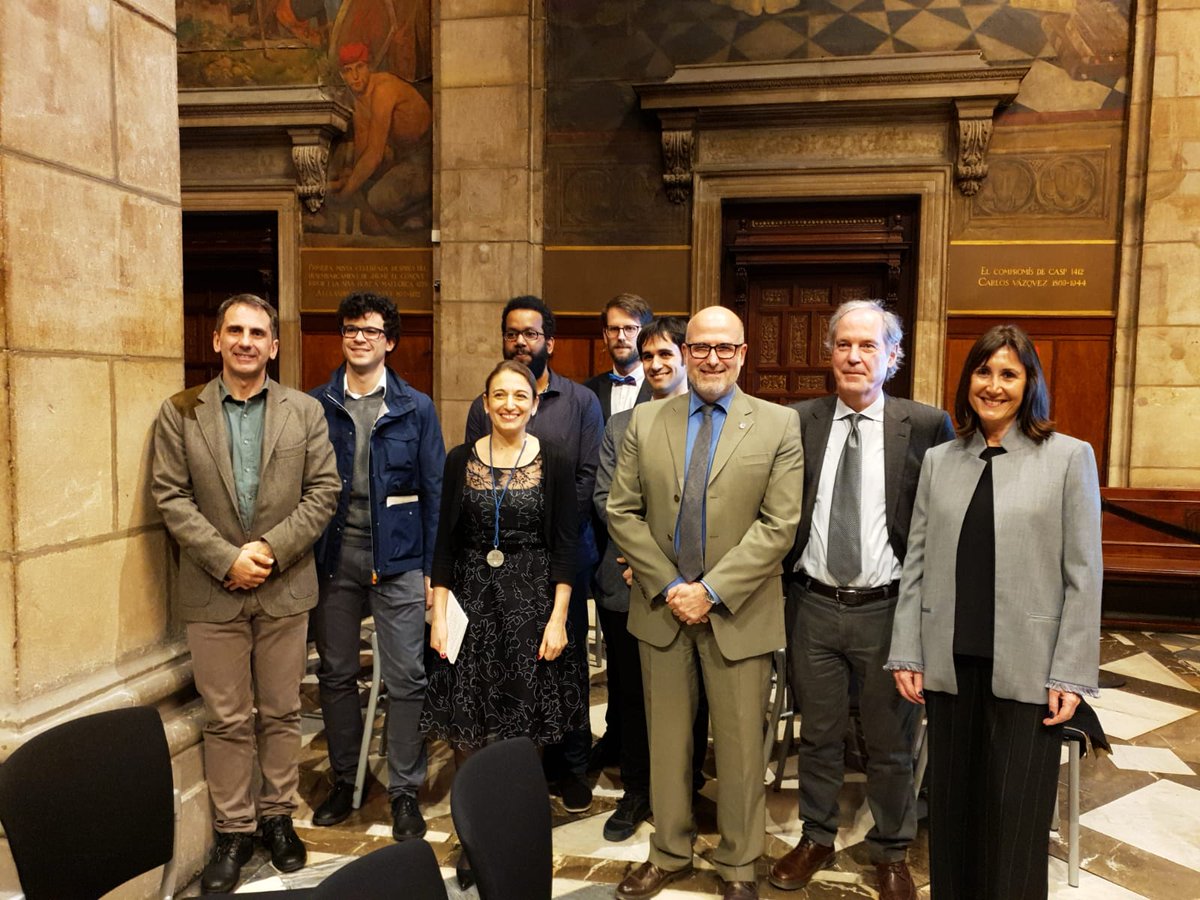
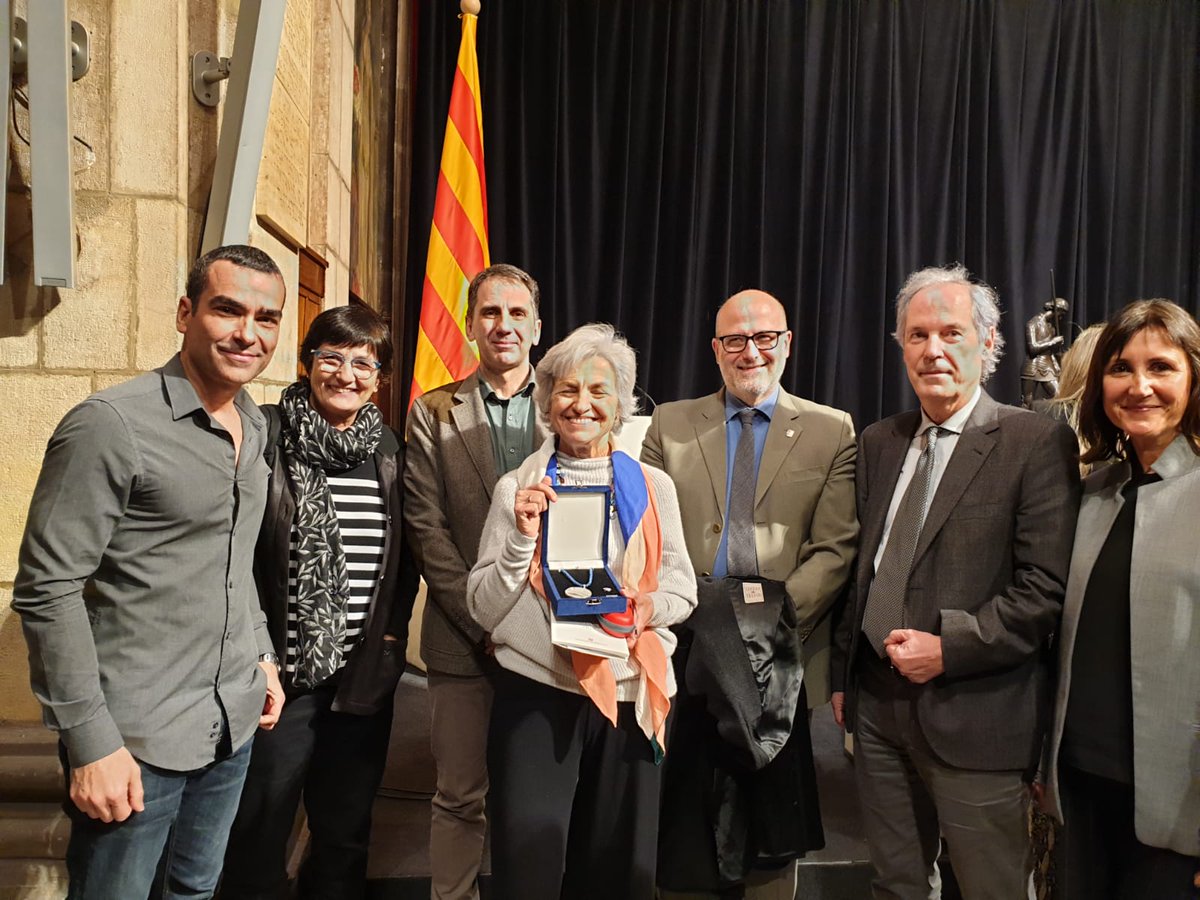
These awards, instituted by the Generalitat in 1982, want to distinguish the people and entities that have contributed significantly to the development of science and technology in Catalonia.
This award is named after an inventor and politician. Narcis Monturiol, born in Figueres in 1819 developed a submarine and a tram, among others. He also created several magazines and newspapers.
About Prof. Jordi Torra
Since the start of the Gaia project, the University of Barcelona has taken a great interest in various aspects of the project, including the photometric aspects, data simulation, and the studies of the prototype data analysis system. In 1999, ESA awarded a contract to the Madrid software company GMV for a study of the data analysis environment for Gaia, a major study supported by the University of Barcelona. Jordi Torra leads the Barcelona work on the data analysis system, liasing with the data base efforts of GMV, the supercomputing centre of Catalunya which supplies the hardware required for the study, and the scientific algorithms provided by the Gaia scientific teams. Jordi is co-leader of the scientific working group on the data processing prototype.
About Prof. Licia Verde
Licia Verde is an astrophysicist with interest in cosmology, which is the study of the origin, evolution and composition of the universe.
Her research topics include theoretical cosmology, cosmic microwave background, large-scale structure, statistical applications and data analysis.
She is interested in the study of the "large-scale distribution of galaxies" and the statistical properties of the heat left over from the big bang to shed light on the universe composition, including the dark energy component, and its history.
She is involved with several projects: Sloan Digital Sky survey III, DESI, Euclid.
She obtained her PhD at the ICCUB in 2017 under the direction of Prof. Jordi Miralda and the research highlighted by Forbes was carried out in the Institute, the article "Quasar – CIV forest cross-correlation with SDSS DR12".
Forbes highlights that "she is studying the distribution of matter in the universe in the era following the formation of the first stars and galaxies. One of ther more recent discoveries has used quasars to examine the presence of carbon in intergalactic clouds 10.8 billion years ago."
In order to celebrate the International Day of Women and Girls in Science, the Institute of Cosmos Sciences releases each day of this week one piece on one of its most renowned researchers.
Today we look into Carme Jordi research:
Position: Associate Professor
Field: Galaxy Structure and Evolution
Research: Her research field includes the physical characterization of single and binary stars and open clusters (young groups of stars in the galactic disc and born from the same molecular cloud), based on astrometric, photometric and spectroscopic observations from ground and space facilities.
She has been involved in space missions such as Hipparcos and INTEGRAL of the European Space Agency (ESA). She is fully engaged in the astrometric space project Gaia since the initial steps in 1997. Her first contributions were related with the definition of science goals and design of the photometric instrument, and currently she participates in the photometric data processing and validation activities within the Data Processing and Analysis Consortium.
She is a member of the Gaia Science Team (the scientific advisory body of ESA for this mission) and of the scientific committee of commission "Astronomical photometry and polarimetry" of the International Astronomical Union. To complement the spectroscopic Gaia data, Carme participates in the large Gaia-ESO survey with the VLT@ESO and in the WEAVE@WHT multiobject spectrograph collaboration. She is part of the "Red Española de Gaia" and "Gaia Research for European Astronomy Training" networks for the scientific exploitation of Gaia data.
Carme also participates in outreach activities for high school students and general public.
In order to celebrate the International Day of Women and Girls in Science, the Institute of Cosmos Sciences releases each day of this week one piece on one of its most renowned researchers.
Today we look into María Concepción García González research:
Position: ICREA Professor
Field: Particle Physics Phenomenolgy
Research: María Concepción García González is a theoretical particle physicist. She studies the fundamental laws that govern the behaviour of the smallest components of Nature: the elementary particles. She does it by comparing the predictions from different theories with measurements performed at accelerators, where high energy beams of matter are made to collide, as well as in experiments which detect the elementary particles arriving to us from outer space, and which were produced in the burning of the stars or during the reactions occurring in the early Universe. The ultimate goal is two-fold: understand the physical laws of the microcosms as well as how they determine the Universe we live in.
She has written over 100 research papers on particle physics phenomenology, as well as some review articles. She is regularly invited to international meetings and conferences and she has given plenary talks at the most important conferences in her area.
In order to celebrate the International Day of Women and Girls in Science, the Institute of Cosmos Sciences releases each day of this week one piece on one of its most renowned researchers.
Today we look into Licia Verde research:
Position: ICREA Professor
Field: Cosmology and Large Scale Structure
Research: Licia Verde is an astrophysicist with interest in cosmology, which is the study of the origin, evolution and composition of the universe.
Her research topics include theoretical cosmology, cosmic microwave background, large-scale structure, statistical applications and data analysis.
She is interested in the study of the "large-scale distribution of galaxies" and the statistical properties of the heat left over from the big bang to shed light on the universe composition, including the dark energy component, and its history.
She is involved with several projects: Sloan Digital Sky survey III, DESI, Euclid.
The last year she was awarded with the Narcis Monturiol medal for their scientific contributions and with the National Research Prize 2018. The jury has valued the work of Licia Verde for its pioneering findings on Universe and to contribute decisively to understand how matter and dark energy are distributed in the universe.
In order to celebrate the International Day of Women and Girls in Science, the Institute of Cosmos Sciences releases each day of this week one piece on one of its most renowned researchers.
Today we look into Assumpta Parreño research:
Position: Associate Professor and deputy director of our Institute.
Field: Hadronic, nuclear and Atomic Physics
Research: Assumpta has focused her research career on understanding how nuclei emerge from the interactions between the fundamental degrees of freedom of matter. Subatomic particles, like neutrons and protons, are not elementary. They can be understood as made up of three quarks, which come in different flavors, giving rise to the different types of particles.
One of the fundamental forces in Nature, the strong force, is responsible for binding these quarks into nucleons. The underlying theory (widely accepted) describing the interactions among quarks is Quantum Chromodynamics, according to which, quarks interact through the exchange of massless elementary particles, the gluons.
Unfortunately, at the energy scales in which nuclear phenomena take place, the theory cannot be solved analytically. With the goal of obtaining numerical solutions to the problem,
Assumpta cofounded in 2004 the international Nuclear Physics with Lattice QCD collaboration. Since then, she has joined several initiatives to use super computation to obtain information about how nuclear particles interact, a framework especially relevant on those sectors where experiments are difficult, or even impossible, to perform.
You can watch her describe her research in the following video (in Spanish):
In order to celebrate the International Day of Women and Girls in Science, the Institute of Cosmos Sciences releases each day of this week one piece on one of its most renowned researchers.
Today we look into Àngels Ramos research:
Position: Full Professor
Field: Nuclear and Hadron Physics
Research: Àngels Ramos is an international reputated and established researcher on strange nuclear physics (the study of the interactions of subatomic particles containing the strange quark and nuclei) where she introduced new disintegration modes and mechanisms.
She was involved in several pioneer studies that demonstrated that the Λ (1405) baryon (a subatomic particle commonly thought as made up of three quarks, as is the case of protons and neutrons) is better described by a superposition of bound hadron-hadron pairs.
In order to celebrate the International Day of Women and Girls in Science, the Institute of Cosmos Sciences releases each day of this week one piece on one of its most renowned researchers.
Today we look into Francesca Figueras research:
Position: Associate Professor
Field: Galaxy Structure and Evolution
Research: Francesca has specialized in the analysis of the movement and physical properties of the stars of the disk of our galaxy with the aim of discovering the mechanisms capable of generating the observed spiral structures. Since 1997 he has been actively participating in the Gaia mission of the European Space Agency (ESA). This satellite is currently continuously observing one billion stars of our galaxy, 1% of its stellar content. She is been actively involved since the begining of the project with the GDAAS (Gaia Data Access and Analysis Study) Phase II, and at present on the validation of the Gaia data (CU9). In 2009 she coordinated "Ella és una astrònoma", in the celebration of the International Year of Astronomy. Francesca is currently the president of the Spanish Astronomy Society.
The Particle Physics Workshop participates at the 1st Biennal Ciutat i Ciència to be held in Barcelona from February 7 to 11. The Biennial organises during five days 70 free dissemination activities distributed in the 10 districts of the city and aims to facilitate the dissemination of scientific knowledge made in Barcelona and strengthen its link with the citizens.
The Particle Physics Workshop aims to bring high school students with special interest in physics closer to one of the most important emerging fields: particle physics. During a day, the students will be able to explore this area with master classes, which the general public can follow through streaming, will make some practical work under the supervision of physicists and will subsequently discuss the results obtained with other participants from around the world.
The Institute of Cosmos Sciences of the University of Barcelona (ICCUB), in collaboration with the Societat Catalana de Física, has organised this workshop since 2005. The attendees of the workshop work with real data obtained with the " LHCb Experiment" at CERN, in which researchers from the ICCUB Experimental Particle Physics group have made important scientific contributions. The activity includes a videoconferencing connection with CERN physicists and other groups of students around the world to discuss their results, coordinated by the International Particle Physics Participation Group (IPPOG).
At the end of the day, students will be able to visit the laboratories of the Faculty of Physics of the University of Barcelona.
https://www.biennalciutaticiencia.barcelona/ca/taller-de-fisica-de-particules


